Auroral Alert
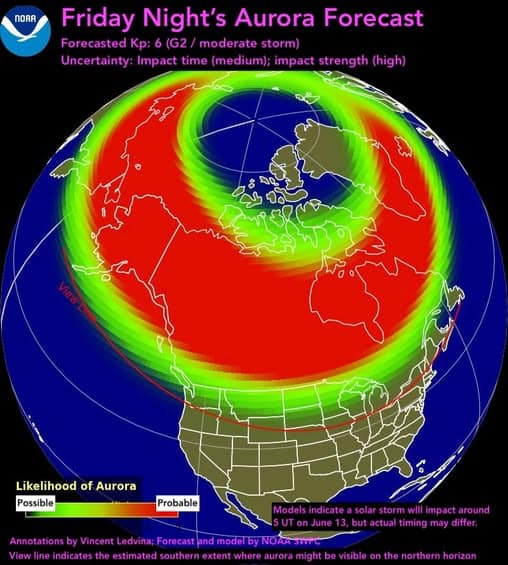 A moderate solar storm could bring the northern lights to the northern U.S. and Canada tonight (Friday, June 12) into early Saturday. NOAA has issued a G2 (“moderate”) geomagnetic storm watch for June 13, with G1 watches on either side for June 12 and 14. If it pans out, the aurora may reach from Canada across the northern states and into parts of the central U.S.
(red donut for attention)
What’s happening: early on June 11, a long-lasting C6.7 flare from sunspot region AR 4465 launched a full-halo CME (a giant cloud of solar plasma) that is partly aimed at Earth. This one is a glancing blow at best. Most of the cloud is heading off to the side of the Sun-Earth line, and sideswipes like this are the hardest events to forecast; just last week several more promising CMEs delivered duds. NASA’s model has it arriving around 3 UT on June 13 (11 PM Eastern, 8 PM Pacific on Friday night), NOAA says about 5 UT, and the HUXt model leans into Saturday morning. All carry at least +/- 7 hours of uncertainty. There’s also a low-confidence chance a slower CME from earlier in the week arrives first with a smaller bump in activity.
The good news: a coronal hole is already streaming fast solar wind at Earth and has been kicking up minor G1 storming on its own. Unlike a CME, fast solar wind doesn’t miss, so the northern tier could see aurora tonight as soon as it gets dark, before the CME even shows up, and the stream keeps Saturday night in play as a backup.
How strong: NOAA’s forecast peaks at G2 (Kp 6) on a scale that runs from G1 to G5. With a glancing blow, how much of the cloud’s flank we catch decides everything, so plan around G2 and be ready for less. One thing about storm watches: NOAA issues them so power grids and satellite operators can plan for the worst case. For aurora chasers, a watch means a chance at aurora, not a guarantee.
How to catch it: get away from city lights, find a clear view to the north, and look during the darkest hours, roughly 11 PM to 3 AM local (June nights are short). Watch for substorms, when the sky can go from dark to full of color in a few minutes. The moon is a thin crescent that rises just before dawn, so darkness won’t be the problem; clouds and the CME actually showing up are.
I am posting the donut of doom map for attention purposes only, but it shows VERY roughly how far south the aurora might be visible tonight.
I sent the full breakdown to my email subscribers this morning, free of charge. Sign up for future alerts here: http://go.theauroraguy.com/alerts
A few more free resources to help you chase:
Live aurora webcams (100+): https://theauroraguy.com/pages/webcams