Arrival Time for CME
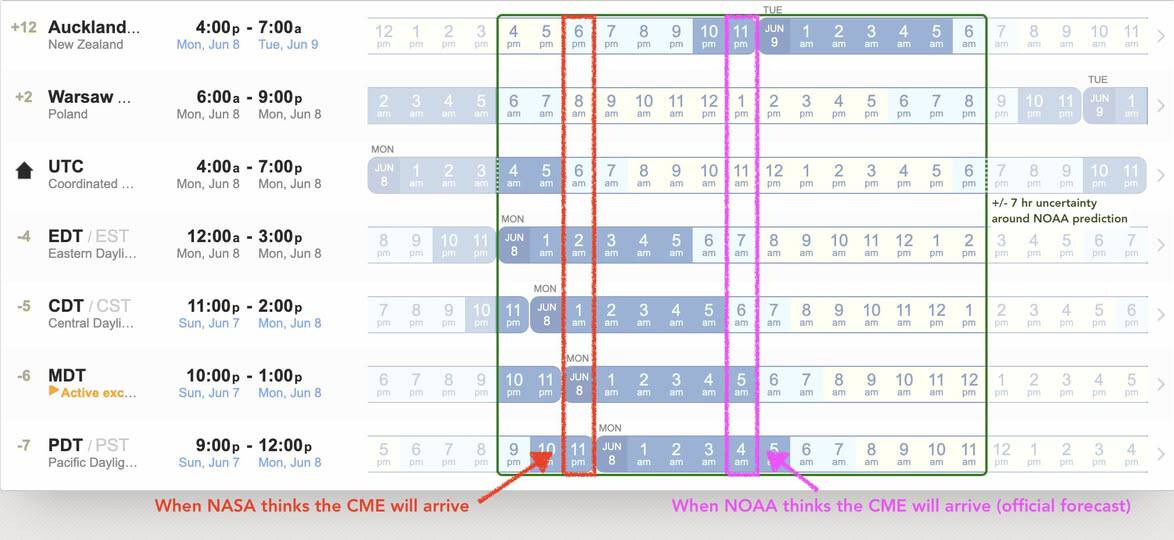
There has been quite the confusion about the arrival time of this CME! Here it is explicitly broken down by popular time zones.
For North Americans, please note that when I say “Sunday night” in my posts, this INCLUDES Monday morning. Sunday night = June 8 UT day, Monday night = June 9 UT day. The G3 watch is for Monday UT day which is effectively Sunday night since 0 UT starts at 8 pm EDT.
Official forecasts from NOAA SWPC are given in UT (Universal Time). This is the same as GMT, UTC, and Zulu time. Your aurora app may automatically convert the UT time zones to your local time zone, so be aware of that.
PSA that whatever happens over the next 24 hours, space weather is HARD to forecast. Our CME could certainly impact tonight, or it could hit near sunrise or even during the day on Monday!
All of these scenarios are possible because forecasts have uncertainty that is rarely talked about by the news/media. On average, solar storm models have a +/- 7 hr uncertainty, so it’s good practice to treat impact times with a grain of salt.
And, there is no one to blame for this. With our current fleet of satellites measuring the Sun and the solar wind, there are only a certain number of data points we can use to create a forecast, and the models forecasters use to issue predictions are ran quickly so that the required stakeholders get advance warning as early as possible.
Also, agencies like NOAA SWPC are not forecasting space weather for you, me, or any other aurora chaser. I am sure they would like to, but keeping the United States and its assets safe is the first priority–like making sure satellite operators know what kind of radiation doses their spacecraft might experience or modeling geomagnetically-induced currents in the ground so power grids can mitigate any blackout risks. What the aurora will do and who will see it is close to
if not at the very bottom of the list for SWPC, which is totally fine. It just means we have to do a little interpretation of the official forecast products on our own to understand what the aurora may do.
Finally, while there are certainly some stations not acting entirely in good faith, most meteorologists are doing their best when it comes to reporting space weather. The majority are not trained in the topics or have the most optimized and scientifically-accurate graphics ready to go for every situation.
Meteorologists will be critical partners and allies as we, as a community, work to bring more awareness to how to “chase wisely” and understand aurora science better.
I just wanted to get this out since over the last 2-3 days, a lot of people have been blaming mets, SWPC, me, other creators, etc. for wrong forecasts or for things not panning out exactly how they wanted. The reality is that forecasts not verifying 100% happens in regular meteorology all the time, we are just used to that. The same is true in space weather, but it’s 5-10x worse–our tech is at the 1970s-level of current terrestrial meteorology and weather forecasting.
Just because a CME didn’t arrive right when you wanted it to does not mean anyone was being deceitful or acting without the best interests. Space weather just “does what it does,” and sometimes it acts in mysterious ways. — Ince Ledvvina, The Aurora Guy